What do you trust more,
your senses or your intuition?
Hyperreality:
The inability of consciousness to distinguish
reality from fantasy, especially in technologically
advanced postmodern cultures.
Hyperreality is a means to characterize the way
consciousness defines what is actually real in a world
where a multitude of media can radically shape
and filter the original event or experience being depicted.
WARNING:
Watching this documentary may disrupt your sense of reality.
Did film director, Stanley Kubrick, help
President Richard Nixon fake the moon landing?
The Dark Side of the Moon
(You must watch all 5 segments in order/Approx. 44 min. total)
Wednesday, February 13, 2008


Wednesday, February 6, 2008
I will survive... why consciousness does not die
When I posted the Humphrey article (two posts ago), I was trying to shed light on opposing ideas on consciousness that are interesting. The fact is, all ideas are mere hypothesis because science has no freaking clue what consciousness is, where it comes from, what its for and what it can do. Just look at the placebo effect. Why is it that the placebo effect is more powerful to heal sometimes than actual drugs?
Anyway, what I didn't mention in either of my two previous posts is that the survival hypothesis has an abundant and significant amount of evidence suggesting an extremely viable alternative to the materialistic interpretations of consciousness.
I'm talking about evidence that has spanned all cultures and all time. Evidence experienced by all types of people, from intellectuals to dopes like me. The evidence is pervasive, yet elusive enough to create the great consciousness debate we have today.
The current paradigm in Scientific Reductionism. The idea that all can be understood by science, everything reduced to some form or another of matter, and that everything in the human mind is the result of evolution, DNA, neurobiology, culture and education.
However, this idea is not shared by all top scientists, and furthermore, the intellectual framework holding up these tenets of materialistic belief are riddle with holes and gaps that cannot be dismissed or talked away with loosely held together science jargon.
Science isn't an exclusive country club, though it would like to be. Through our critical thinking and careful analysis, we are all granted admission to the deepest thoughts that are still left unanswered. Though I'm not a scientist, I can think scientifically like anyone else.
Obviously as a professional medium, my ideas and opinions about consciousness survival have been developed through personal experience and experimentation. Of course, my subjective experience cannot replace scientific inquiry, that's why I look to unbiased scientific research to make the claims I've observed.
Anyone truly interested in the subject of consciousness survival can easily access this data in numerous articles, papers and books available online and beyond.
Recommendations:
Irreducible Mind
Parapsychology and the Skeptics
Immortal Remains
Best Evidence
The Conscious Universe
Entagled Minds
The Afterlife Experiments
The Trickster and the Paranormal
This site also has a decent summary of the evidence, science and principles supporting the survival hypothesis.
Anyway, what I didn't mention in either of my two previous posts is that the survival hypothesis has an abundant and significant amount of evidence suggesting an extremely viable alternative to the materialistic interpretations of consciousness.
I'm talking about evidence that has spanned all cultures and all time. Evidence experienced by all types of people, from intellectuals to dopes like me. The evidence is pervasive, yet elusive enough to create the great consciousness debate we have today.
The current paradigm in Scientific Reductionism. The idea that all can be understood by science, everything reduced to some form or another of matter, and that everything in the human mind is the result of evolution, DNA, neurobiology, culture and education.
However, this idea is not shared by all top scientists, and furthermore, the intellectual framework holding up these tenets of materialistic belief are riddle with holes and gaps that cannot be dismissed or talked away with loosely held together science jargon.
Science isn't an exclusive country club, though it would like to be. Through our critical thinking and careful analysis, we are all granted admission to the deepest thoughts that are still left unanswered. Though I'm not a scientist, I can think scientifically like anyone else.
Obviously as a professional medium, my ideas and opinions about consciousness survival have been developed through personal experience and experimentation. Of course, my subjective experience cannot replace scientific inquiry, that's why I look to unbiased scientific research to make the claims I've observed.
Anyone truly interested in the subject of consciousness survival can easily access this data in numerous articles, papers and books available online and beyond.
Recommendations:
Irreducible Mind
Parapsychology and the Skeptics
Immortal Remains
Best Evidence
The Conscious Universe
Entagled Minds
The Afterlife Experiments
The Trickster and the Paranormal
This site also has a decent summary of the evidence, science and principles supporting the survival hypothesis.
Tuesday, February 5, 2008
Toward a theory of consciousness survival
A commenter in my previous post asked me "what is the consciousness survival theory?" Great question, as there actually isn't a unified theory of consciousness survival. I often make the mistake that many others do by interchangeably using the words "hypothesis" and "theory". These two words in the framework of the scientific method are quite different, and it is wrong to interchange them the way that I have.
I meant, the "survival hypothesis", which stipulates that consciousness co-exists (at least for a time) in both a physical and non-physical form. The most obvious question based on this hypothesis is, "what exactly is consciousness?"
The answer to that question is, "nobody really knows." So technically, the survival hypothesis itself is very weak, in that the focal point of the hypothesis is an undefined "thing" which can neither be described nor measured (not yet).
I believe we are several years away from having a real definition of consciousness and decades away from the hope of having a theory that can be tested.
Some people compare the survival hypothesis to the theory of gravity. They point out that there's still a lot about the theory of gravity we don't know or understand, yet we know it's there from observation.
For those who are interested in the search for consciousness and a survival hypothesis/theory, here is a well-written, balanced, yet slightly skeptical summary of where we currently stand.
National Institute for Discovery Science: Survival of Consciousness by James Whinnery, M.D.
I meant, the "survival hypothesis", which stipulates that consciousness co-exists (at least for a time) in both a physical and non-physical form. The most obvious question based on this hypothesis is, "what exactly is consciousness?"
The answer to that question is, "nobody really knows." So technically, the survival hypothesis itself is very weak, in that the focal point of the hypothesis is an undefined "thing" which can neither be described nor measured (not yet).
I believe we are several years away from having a real definition of consciousness and decades away from the hope of having a theory that can be tested.
Some people compare the survival hypothesis to the theory of gravity. They point out that there's still a lot about the theory of gravity we don't know or understand, yet we know it's there from observation.
For those who are interested in the search for consciousness and a survival hypothesis/theory, here is a well-written, balanced, yet slightly skeptical summary of where we currently stand.
National Institute for Discovery Science: Survival of Consciousness by James Whinnery, M.D.
Wednesday, January 30, 2008
Trying to Unravel The Consciousness Conundrum Pt. 1
 Though this article from SEED magazine completely ignores the theory of consciousness survival, Nicholas Humphrey's observations posit an incredibly creative and perfectly thought-out theory on the evolutionary purpose and mystery behind human consciousness.
From the article...
"The philosopher Jerry Fodor recently claimed, 'The revisions of our concepts and theories that imagining a solution will eventually require are likely to be very deep and very unsettling.'SEED article
If you smell theoretical panic, you're right. But are the scientific answers really so far out of reach? Have people been beguiled by the marvelous properties of consciousness into asking for the moon, while what is at issue is really much more down to earth? Everybody says they are waiting for the Big Idea. But perhaps the big idea should be that consciousness, which is of such significance to us subjectively, is scientifically not such a big deal."
Friday, December 14, 2007
Always Entertaining
Poltergeist stories are always entertaining. Even when you know the story is exaggerated or plain ridiculous, you can't help but be glued to it.
The funny thing about me criticizing these type of stories is that I actually lived one myself. As a teenager, I had a poltergeist in my room, some scary things happened and eventually a Catholic priest was called in to bless my room and rid it of the "energy" so I could move back into it.
Looking back on the situation now as an adult, I still have to laugh. Not because what happened in my room didn't happen or because I don't believe that these things occur. I laugh because, when they do happen, they always read like some badly written yarn out of a 1950's pulp fiction novel.
The World's Scariest Ghosts Caught on Tape
Here's a show I imagine raised the hairs on many people's arms. It's well done and perfectly edited. This is not to say there aren't some classic cheesy ghost story elements in it, there are. My point is, whether you're a skeptic or not, it's hard to turn away from a good ghost story.
Highlights of the show...
[BAD] In one segment, James Van Praagh's questioning of the little boy, with numerous leading comments to draw a positive response, is extremely embarrassing.
[GOOD] The most compelling segment begins at minute 30 when we get to see video imagery of Orbs caught on tape. Some of the orb patterns do look like bugs flying the night, but there is a video of a grapefruit size orb that is truly intriguing.
Judge for yourself.
The funny thing about me criticizing these type of stories is that I actually lived one myself. As a teenager, I had a poltergeist in my room, some scary things happened and eventually a Catholic priest was called in to bless my room and rid it of the "energy" so I could move back into it.
Looking back on the situation now as an adult, I still have to laugh. Not because what happened in my room didn't happen or because I don't believe that these things occur. I laugh because, when they do happen, they always read like some badly written yarn out of a 1950's pulp fiction novel.
The World's Scariest Ghosts Caught on Tape
Here's a show I imagine raised the hairs on many people's arms. It's well done and perfectly edited. This is not to say there aren't some classic cheesy ghost story elements in it, there are. My point is, whether you're a skeptic or not, it's hard to turn away from a good ghost story.
Highlights of the show...
[BAD] In one segment, James Van Praagh's questioning of the little boy, with numerous leading comments to draw a positive response, is extremely embarrassing.
[GOOD] The most compelling segment begins at minute 30 when we get to see video imagery of Orbs caught on tape. Some of the orb patterns do look like bugs flying the night, but there is a video of a grapefruit size orb that is truly intriguing.
Judge for yourself.
Wednesday, December 5, 2007
Rolando y La Recoleta
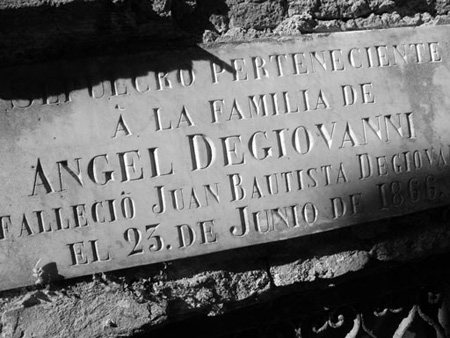 I'm going home. Well, my second home, anyway. In April of next year, I will be returning to Argentina for the first time in six and a half years.
Last time I was there, the country was weeks from spilling over into one of the worst economic and political crises of it's history. Last time around, my father was also alive.
It will be weird visiting my father's grave site for the very first time since he died this past July. I'm not sure what I'll feel, really. I'm not sure what I feel about Rolando, even now.
My father was without equal. A real character and a true enigma. He was the type of person you'd expect to find in a Charles Dickens novel via a Gabriel Garcia Marquez fairytale. The type of trickster you take gerat delight in hearing about, but great joy in knowing he's not your father, yet for me, he is my father.
After taking in my father's grave, I'll probably make my way to La Recoleta. Whenever I journey back to my ancestral home, Buenos Aires to more specific, I always make a trek to the city of the dead, La Recoleta. One of the most amazing and artistic enclaves of marble mausoleums in the world. In addition to housing beautiful sculptured final resting places, La Recoleta is also home to a large colony of feral cats and several Argentine luminaries, including Broadway's favorite, controversial first lady, Eva Peron.
Traveling back in time to the more tender parts of the heart is never easy. However, I like not easy. I guess that's part of my genetic inheritance - taking the road less safe. This will always be one of my strongest bonds with my Father - our ability to find trouble even in a nursery of newborns. Yet, trouble can be rewarding in the most unexpected ways.
Some pretty pictures of La Recoleta
Tuesday, December 4, 2007
Dream Visitations
On the latest episode of AfterlifeFM, I interviewed Kevin Kovelant, blogger of Streamsofconsciouseness.org and Masters candidate in Consciousness Studies at JFK University about dream visitations and how spirit uses them as a method of communication.
Subscribe to:
Posts (Atom)