Wednesday, May 14, 2008

God, Einstein, and I quote...

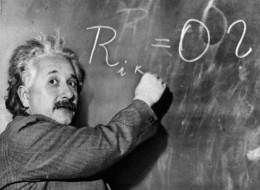
Warriors, both of science and of faith, have for years played a tug-of-war for the heart and soul of Albert Einstein. We all knew from early on that his mind belonged to science, but what of his true essence, his belief in something grander than the playground that is our cosmos.

Currently, there is an auction making some noise in the halls of science and cheering up its atheist practitioners. The auction is of a personal letter Albert Eistein wrote in 1954 (one year prior to his passing) that "unequivocally" states his disbelief in God.

Dr. EInstein writes,
"The word God is for me nothing more than the expression and product of human weaknesses, the Bible a collection of honourable, but still primitive legends which are nevertheless pretty childish."
He also goes on to say in the letter written to the philosopher Eric Gutkind,
"No interpretation no matter how subtle can (for me) change this."
Frankly, I don't see this "new" letter to be revealing anything we didn't already know about our quotable pal, Einstein. Einstein made it clear on several occasions that he did not ascribe to the Abrahamic concept of God, most famously in his "Spinoza" quote,
"I believe in Spinoza's God who reveals himself in the orderly harmony of what exists, not in a God who concerns himself with the fates and actions of human beings."
Einstein, in addition to his brilliant observations in physics, also made some profound philosophical observations. It is these more romantic and social leanings which often places Einstein in the middle of this battle of beliefs. Einstein once famously stated,
"Science without religion is lame, religion without science is blind."
Then there is his most confusing quote about God,
"I want to know how God created this world. I am not interested in this or that phenomenon, in the spectrum of this or that element. I want to know his thoughts. The rest are details."
However, my favorite Einstein quote, which not only establishes his disbelief in an Abrahamic God, but also distances himself from the rhetoric of hardcore atheists is this one,
"I have repeatedly said that in my opinion the idea of a personal God is a childlike one, but I do not share the crusading spirit of the professional atheist whose fervor is mostly due to a painful act of liberation from the fetters of religious indoctrination received in youth. I prefer an attitude of humility corresponding to the weakness of our intellectual understanding of nature and of our own being.
To me, this quote is the essence of Einstein - a respect and humility for human kind and an understanding that our knowledge of nature, its order and the further discoveries that await us, are what give rise to passionate living.

Truthfully, I hope everyone stops quoting Albert Einstein after this auction. It's time we took the question of "consciousness survival" out of the hands of scientists, and put it back into the hands of science.

Read more on the auction of Albert Einstein's letter

Tuesday, May 13, 2008

Drunks in Heaven

Posted by Jackson Citizen Patriot May 12, 2008 08:05AM

Bill Bramanti has booked an unconventional passage into the afterlife. Whether you like it or not is a matter of taste, and we don't mean the taste of beer.

The South Chicago Heights, Ill., man loves Pabst Blue Ribbon so much that he ordered — and received — a custom-made beer-can casket. The 67-year-old celebrated recently with a party and filled the red, white and blue coffin with ice and beer.

"I actually fit, because I got in here," Bramanti told the Associated Press.

Why go to such lengths? And for Pabst beer? We don't dare understand. We should note, however, that he's not the first to prepare for mortality in what we might consider unconventional ways.

Ancient Egyptians were buried with everyday objects, and wealthier ones would have coffins filled with jewelry and other valuable items. Some Inuits in Alaska would leave the dead in igloos, where the body could remain intact on ice for eternity. In Jamaica, death would bring on a celebration involving dancing, singing and 100-proof rum.

No beer, though. Hmm.

Then again, in March archaeologists in Britain dug up a 4,000-year-old skeleton with an ornate pot at its feet that one researcher said could have been "a type of beer mug."

All that's missing were the peanuts.


Wednesday, March 12, 2008

Tarot for your Chemistry Class


In the cool and interesting department...

The Elemental Hexagons deck is an oracle deck based on the Periodic Table of the elements. It is somewhat like a Tarot deck in that all of the Major Arcana cards are represented, but none of the Minor Arcana are. The deck consists of 60 cards, where each card represents a single element. Just about 2/3rds of the known stable elements are represented.

Elemental Hexagons Oracle Cards on Squidoo

Wednesday, February 13, 2008

The Collective Conspiracy of Consciousness

What do you trust more,
your senses or your intuition?


Hyperreality:


The inability of consciousness to distinguish
reality from fantasy, especially in technologically
advanced postmodern cultures.

Hyperreality is a means to characterize the way
consciousness defines what is actually real in a world
where a multitude of media can radically shape
and filter the original event or experience being depicted.


WARNING:
Watching this documentary may disrupt your sense of reality.


Did film director, Stanley Kubrick, help
President Richard Nixon fake the moon landing?


The Dark Side of the Moon

(You must watch all 5 segments in order/Approx. 44 min. total)


Wednesday, February 6, 2008

I will survive... why consciousness does not die

When I posted the Humphrey article (two posts ago), I was trying to shed light on opposing ideas on consciousness that are interesting. The fact is, all ideas are mere hypothesis because science has no freaking clue what consciousness is, where it comes from, what its for and what it can do. Just look at the placebo effect. Why is it that the placebo effect is more powerful to heal sometimes than actual drugs?

Anyway, what I didn't mention in either of my two previous posts is that the survival hypothesis has an abundant and significant amount of evidence suggesting an extremely viable alternative to the materialistic interpretations of consciousness.

I'm talking about evidence that has spanned all cultures and all time. Evidence experienced by all types of people, from intellectuals to dopes like me. The evidence is pervasive, yet elusive enough to create the great consciousness debate we have today.

The current paradigm in Scientific Reductionism. The idea that all can be understood by science, everything reduced to some form or another of matter, and that everything in the human mind is the result of evolution, DNA, neurobiology, culture and education.

However, this idea is not shared by all top scientists, and furthermore, the intellectual framework holding up these tenets of materialistic belief are riddle with holes and gaps that cannot be dismissed or talked away with loosely held together science jargon.

Science isn't an exclusive country club, though it would like to be. Through our critical thinking and careful analysis, we are all granted admission to the deepest thoughts that are still left unanswered. Though I'm not a scientist, I can think scientifically like anyone else.

Obviously as a professional medium, my ideas and opinions about consciousness survival have been developed through personal experience and experimentation. Of course, my subjective experience cannot replace scientific inquiry, that's why I look to unbiased scientific research to make the claims I've observed.

Anyone truly interested in the subject of consciousness survival can easily access this data in numerous articles, papers and books available online and beyond.

Recommendations:

Irreducible Mind
Parapsychology and the Skeptics
Immortal Remains
Best Evidence
The Conscious Universe
Entagled Minds
The Afterlife Experiments
The Trickster and the Paranormal

This site also has a decent summary of the evidence, science and principles supporting the survival hypothesis.

Tuesday, February 5, 2008

Toward a theory of consciousness survival

A commenter in my previous post asked me "what is the consciousness survival theory?" Great question, as there actually isn't a unified theory of consciousness survival. I often make the mistake that many others do by interchangeably using the words "hypothesis" and "theory". These two words in the framework of the scientific method are quite different, and it is wrong to interchange them the way that I have.

I meant, the "survival hypothesis", which stipulates that consciousness co-exists (at least for a time) in both a physical and non-physical form. The most obvious question based on this hypothesis is, "what exactly is consciousness?"

The answer to that question is, "nobody really knows." So technically, the survival hypothesis itself is very weak, in that the focal point of the hypothesis is an undefined "thing" which can neither be described nor measured (not yet).

I believe we are several years away from having a real definition of consciousness and decades away from the hope of having a theory that can be tested.

Some people compare the survival hypothesis to the theory of gravity. They point out that there's still a lot about the theory of gravity we don't know or understand, yet we know it's there from observation.

For those who are interested in the search for consciousness and a survival hypothesis/theory, here is a well-written, balanced, yet slightly skeptical summary of where we currently stand.

National Institute for Discovery Science: Survival of Consciousness by James Whinnery, M.D.


Wednesday, January 30, 2008

Trying to Unravel The Consciousness Conundrum Pt. 1

Though this article from SEED magazine completely ignores the theory of consciousness survival, Nicholas Humphrey's observations posit an incredibly creative and perfectly thought-out theory on the evolutionary purpose and mystery behind human consciousness.

From the article...
"The philosopher Jerry Fodor recently claimed, 'The revisions of our concepts and theories that imagining a solution will eventually require are likely to be very deep and very unsettling.'

If you smell theoretical panic, you're right. But are the scientific answers really so far out of reach? Have people been beguiled by the marvelous properties of consciousness into asking for the moon, while what is at issue is really much more down to earth? Everybody says they are waiting for the Big Idea. But perhaps the big idea should be that consciousness, which is of such significance to us subjectively, is scientifically not such a big deal."
SEED article