This is the coolest thing ever! Part of a GE marketing effort to promote "the Smart Grid;" you can create a visual 3-D hologram from a 2 dimensional piece of paper you print at home. It really,really works. Spin your hologram in a 180 degree angle for some really cool effects. Turn it upside down to get really freaky!
Note: You will need to install the latest version of Flash Player (free) to see the hologram in action.
Click here to get started.
Well worth the effort.
Monday, March 23, 2009


Tuesday, March 17, 2009
Consciousness On The Operating Table
 According to this article from Discover online, anesthesiologists may soon be able to gauge consciousness much as doctors gauge a patient’s temperature with a thermometer. Perhaps some of the mystery of consciousness itself—a question that has vexed philosophers for centuries—will be solved on the operating table.
I was looking forward to my first experience with anesthesia. I had been laid out on a stretcher, and nurses and doctors were prepping my midsection so they could slice it open and cut out my appendix. After a bout of appendicitis, a short vacation from consciousness seemed like a pleasant way to spend a few hours. I had no idea what anesthesia would actually feel like, though, and suddenly I was seized by skepticism. I tried to hoist myself up, already swabbed in iodine, as I suggested that I ought to pop into the men’s room before the scalpels came out. I wouldn’t want to interrupt the surgery with a bathroom break. “Don’t worry,” one of the nurses replied. “We’ll do that for you.”
I lay back down, puzzling over that. After a nurse put the IV into my hand, I had to interrupt again: The anesthesia flowing into my arm was not working. I just couldn’t believe that anything would keep me asleep while someone was knitting up my intestines. The nurses and doctors nodded in my direction as I tried to explain the problem to them, but I was sure they weren’t taking me seriously. I took a long, slow blink. And then there were no doctors and nurses around me. I was lying alone in a new room, recovering from my surgery.
Ever since that experience, I’ve wondered what exactly happened in my head. It didn’t feel like sleep. It was not a blackout, either. It was as if the surgeons had simply cut a few hours out of my life and joined together the loose ends. So I decided to get more familiar with the science behind anesthesia. To my surprise, I discovered that anesthesiologists are a bit in the dark themselves. “How anesthesia works has been a mystery since the discovery of anesthesia itself,” writes Michael Alkire, an anesthesiologist at the University of California at Irvine School of Medicine, in the new Encyclopedia of Consciousness.
The first public demonstration of anesthesia during surgery took place in 1846 in Boston. A man named Gilbert Abbott took some deep drafts of ether, and surgeons began cutting a tumor off his jaw. The audience was shocked that Abbott did not scream and squirm. One London newspaper expressed the amazement that many must have felt: “Oh, what delight for every feeling heart to find the new year ushered in with the announcement of this noble discovery of the power to still the sense of pain and veil the eye and memory from all the horrors of an operation.”
Today anesthesiologists have a number of drugs to choose from, as well as machines to administer them safely. Every year tens of millions of people get general anesthesia. In 2008 Columbia University epidemiologist Guohua Li reported that each year only one person in a million suffers an anesthesia-related death in the United States. But for all these achievements, anesthesia remains deeply puzzling.
To begin with, anesthesiologists have no precise way to determine when people lose consciousness. In Abbott’s day, doctors would simply ask their patients to respond, perhaps by opening their eyes. A lack of response was taken as a sign of unconsciousness. Many modern anesthesiologists talk to their patients, but judging the response is made more complicated by the muscle relaxants that they also use. Sometimes the anesthesiologist will use a blood pressure cuff on a patient’s arm to block the muscle relaxants in the bloodstream. Then the doctor asks the patient to squeeze a hand.
This sort of test can distinguish between a patient who is awake and one who is out cold. But at the borderline of consciousness, it is not very precise. The inability to raise your hand, for example, doesn’t necessarily mean that you are unconscious. Even a light dose of anesthesia can interfere with your capacity to keep new pieces of information in your brain, so you may not respond to a command because you immediately forgot what you were going to do. On the other hand, squeezing an anesthesiologist’s hand may not mean you’re wide awake. Some patients who can squeeze a hand will later have no memory of being aware.
Seeking a more reliable measuring stick, some researchers have started measuring brain waves. When you are awake, your brain produces fast, small waves of electrical activity. When you are under total anesthesia, your brain waves become deep and slow. If you get enough of certain anesthetics, your brain waves eventually go flat. Most anesthesiologists monitor their patients using a machine known as a bispectral index monitor, which reads brain waves from electrodes on a patient’s scalp and produces a score from 100 to 0. But these machines aren’t precise either. Sometimes patients who register as unconscious can still squeeze a hand on command.
The problem with all these methods is that anesthesiologists don’t really know what it is they are trying to measure. So Alkire and other scientists are using neuroimaging to peer into the anesthetized brain to see what happens when it succumbs. In a typical experiment, a volunteer lies in an fMRI brain scanner, which can measure the amount of oxygen used in different parts of the brain. A researcher gives the volunteer anesthesia and measures how those brain regions respond.
+++
Such studies find that the entire brain powers down on anesthesia, its activity dropping between 30 and 60 percent. The results are somewhat ambiguous, since brain regions respond differently to different drugs. But one region consistently becomes quieter than average: a grape-size cluster of neurons almost dead center in the brain known as the thalamus.
Is the thalamus the brain’s power switch? It certainly has the right stuff for the job. A thicket of neurons sprout from the thalamus and branch across the cortex, the outer layer of the brain where we interpret the information from our senses and make decisions, then back into the thalamus. As the brain’s sensory relay station, the thalamus is responsible for sending rousing signals to the cortex when we wake up from ordinary sleep. In 2007 Alkire and his collaborators probed the role of the thalamus by putting rats in a box flooded with anesthetics, which caused the animals to keel over. If Alkire and his colleagues then injected a tiny dose of nicotine into the thalamus, the rats immediately came to and stayed conscious even as they continued to inhale the anesthetics.
Yet studies on patients with Parkinson’s disease show that the thalamus cannot completely explain how anesthesia works. Surgeons can treat Parkinson’s by implanting electrodes deep inside the brain. These electrodes release pulses of current to tamp down the wild movements associated with the disease. Lionel Velly, an anesthesiologist at Mediterranean University in Marseille, France, ran an experiment in which he used the electrodes in the other direction, to record electrical activity in the brain.
In a second surgical procedure less than a week after the brain surgery, Velly and his colleagues took readings from the deep-brain electrodes in 25 patients while also collecting electrode readings from their scalp. The scalp recordings let the scientists monitor the cortex, while the deep-brain electrodes let them monitor the thalamus. Velly’s team found that the cortex started producing deep, slow waves as soon as patients became unresponsive. The thalamus, on the other hand, didn’t change for another 15 minutes. The pattern Velly saw was the reverse of what you would expect if the thalamus were the brain’s master switch.
The secret of anesthesia may lie not in any single clump of neurons but in the conversations taking place between many clumps in the brain.
Giulio Tononi, a University of Wisconsin neuroscientist, suggests that the secret of anesthesia may not in fact lie in any single clump of neurons. It may lie instead in the conversations that take place between many clumps in the brain. Normally information from our senses races from one region of the cortex to another, getting processed in different ways in each place. Some regions help us recognize faces in a scene, for example, while other regions help us figure out what emotions those faces are expressing. The sensory signals travel through a mass transit system made up of long branches of neurons that crisscross the brain. This system has a few hubs through which many connections pass. One is the thalamus, but certain parts of the cortex also serve as hubs.
Although the brain may become less active under anesthesia, it usually doesn’t shut down completely (if it did, we would die). In fact, when scientists played a tone into the ears of an anesthetized cat, its cortex still produced strong bursts of electricity. But its responses were different from those of a waking cat. In an anesthetized cat, the brain responds the same way to any sound, with a noisy crackle of neurons. In a waking cat, the response is complex: One brain region after another responds as the animal processes the sound, and different sounds produce different responses. It’s as if the waking brain produces a unique melody, whereas the anesthetized brain can produce only a blast of sound or no sound at all.
Tononi suggests that this change happens because anesthesia interferes with the brain’s mass transit system. Individual parts of the cortex can still respond to a stimulus. But the brain can’t move these signals around to other parts to create a single unified experience.
Tononi argues that the difference between brain music and brain noise defines the very nature of consciousness. Consciousness is the brain’s ability to be in a complex state, even in response to a simple stimulus like a tone. The vast number of different states our brains can enter when we are aware gives consciousness its marvelously rich feeling. In order to produce those states, the brain needs lots of neural elements that are active and able to respond, as well as the mass transit system that links them all together.
Working from this hypothesis, Tononi and his colleagues are trying to develop tools that can monitor levels of consciousness in anesthetized patients. They are also developing software to measure the complexity of the brain’s responses to stimuli. If Tononi’s idea is correct, anesthesiologists may be moving toward being able to gauge consciousness much as doctors gauge a patient’s temperature with a thermometer. Perhaps some of the mystery of consciousness itself—a question that has vexed philosophers for centuries—will be solved on the operating table.
Wednesday, February 25, 2009
James Randi - The Coward That Blinked
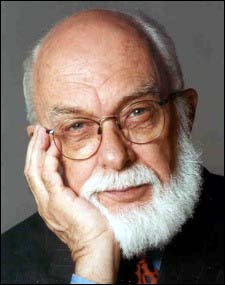 Hat tip:Entangled Minds.
The following post comes from this article.
In 2002 the BBC Horizon program presented a documentary that showed that the Benveniste experiment about homeopathy was a fake one and therefore... homeopathy was also fake!
Mr.Vithoulkas had repeatedly stressed in many communications that the experiment was in any case a falsely conceived one from its very beginning (see the correspondence). The opponents of homeopathy basing in this false experiment by Benveniste their hypocritical arguments maintained that homeopathy was simply placebo effect.
Mr Randi after this false experiment (ignoring all other experiments that showed the effect of homeopathy) declared in his website (http://www.randi.org/) that whoever could prove the validity of the action of a homeopathically potentized remedy beyond the Avogadro number would be winning one million $ as a prize.
Mr Vithoulkas challenged this statement and with this idea a new experiment was conceived that would prove that the highly potentized remedies could actually have a biological effect upon the human organism.
The experiment was simple: An individualized remedy would be given to a number of patients in a double blind fashion and half of the patients would receive placebo the other half would get the real remedy. The Greek Homeopathic physicians that would participate in taking of the cases and prescribing the remedies should point out in the end of the experiment the ones that they had got the real remedy.
The protocol was structured by a group of internationally known scientists and the experiment had to take place in one of the hospitals in Athens.
What follows is the real story (with facts in correspondence that transpired) of how through several "tricks", Mr.Randi refused to go through the experiment and rescued his million.
We sent the following statement to Mr. Randi in order to be posted to his website but he refused to post it. Full Story.
To read more about how James Randi backed out of a challenge, read -Randi Backs Out of Challenge with Homeopath George Vithoulkas
Monday, February 16, 2009
It's getting cold in here...
With the recent popularity of the TV show, The Mentalist, there's been a renewed interest in "cold reading" techniques that many skeptics claim is the foundation for psychic or mediumship readings.
Fraud exists everywhere in the psychic/mediumship world. At all levels. Sometimes that fraud is perpetrated with forethought, other times, it's just a byproduct of self-delusion. However, when you remove all the questionable and objectionable evidence from the mix, you are still left with volumes of evidence and experiments that beg the question, "Is there more to consciousness that meets the mind?"
So, back to the cold reading claim. I recently found a post (http://www.wikihow.com/Cold-Read) that gives its readers very detailed directions in how to portray yourself as a psychic or medium. Here's the intro to the article -
In any major research protocol dealing with anomalous cognition, rigorous steps are taken to eliminate any possibility of cold reading as a possible explanation. Eliminating this explanation doesn't prove "life after death", but it does require the skeptical community to shed, once and for all, their automated rejection of the question that is still hanging out there, and like I said earlier, begging investigation, "Is there more to consciousness that meets the mind?"
Fraud exists everywhere in the psychic/mediumship world. At all levels. Sometimes that fraud is perpetrated with forethought, other times, it's just a byproduct of self-delusion. However, when you remove all the questionable and objectionable evidence from the mix, you are still left with volumes of evidence and experiments that beg the question, "Is there more to consciousness that meets the mind?"
So, back to the cold reading claim. I recently found a post (http://www.wikihow.com/Cold-Read) that gives its readers very detailed directions in how to portray yourself as a psychic or medium. Here's the intro to the article -
"Want to be a hit at the next party? Perform a cold reading, and you can amaze - maybe even frighten - people with your psychic abilities. Don't worry though; no actual psychic ability is required. Cold reading is a classic trick used by magicians, soothsayers, TV psychics, and other entertainers and charlatans. By asking a person the right questions, listening carefully, and making a guess or two, you can convince even many skeptics that you really are able to communicate with the spirit world.I am posting the intro and link here for two reasons. One, it serves as a warning to gullible people that bad psychics and mediums do exist, and they do use these techniques. Two, it serves as a reminder of how shallow and ignorant skeptical arguments are against valid scientific research into consciousness survival.
In any major research protocol dealing with anomalous cognition, rigorous steps are taken to eliminate any possibility of cold reading as a possible explanation. Eliminating this explanation doesn't prove "life after death", but it does require the skeptical community to shed, once and for all, their automated rejection of the question that is still hanging out there, and like I said earlier, begging investigation, "Is there more to consciousness that meets the mind?"
Wednesday, December 17, 2008
Brett Dennen - "Ain't No Reason"
Brett Dennen is a master singer/songwriter who deserves attention and accolades from music lovers worldwide. Check out his video for the song, "Ain't no reason."
Friday, December 12, 2008
The Folly of Pride
Pride is an elevator that never stops to let you off, but always waits for you to get in. It takes you to the highest level of achievement, then lowers you to the highest level of self-deception. Case in point, Illinois Gov. Rod Blagojevich. The audacity of his corruption and lack of his self-restraint will become infamous in the annals of political idiots.
Charles W. Colson, a former aide to President Nixon, was also once a passenger on the elevator of pride, until he realized that he had to escape through the ceiling trap, and jump off.
In a revealing CNN.com editorial, (highly recommended reading) Charles W. Colson, exposes the folly of pride that took him down with the Watergate scandal and landed him in Prison. In his editorial, Mr. Colson does an amazing job in identifying the spiritual corruption that is often the negative side effect of personal pride.
One of my favorite quotes in the editorial, is a quote from Alexander Solzhenitsyn, who wrote from the gulag, "Bless you, prison, bless you for being in my life, for there, lying on the rotting prison straw, I came to realize that the object of life is not prosperity, as we are made to believe, but the maturing of the human soul.
No, you don't have to be a politician to ride the elevator of pride, trust me, I know. You just have to invest in the "culture of self" to such a degree that you no longer recognize the self in selflessness.
Charles W. Colson, a former aide to President Nixon, was also once a passenger on the elevator of pride, until he realized that he had to escape through the ceiling trap, and jump off.
In a revealing CNN.com editorial, (highly recommended reading) Charles W. Colson, exposes the folly of pride that took him down with the Watergate scandal and landed him in Prison. In his editorial, Mr. Colson does an amazing job in identifying the spiritual corruption that is often the negative side effect of personal pride.
One of my favorite quotes in the editorial, is a quote from Alexander Solzhenitsyn, who wrote from the gulag, "Bless you, prison, bless you for being in my life, for there, lying on the rotting prison straw, I came to realize that the object of life is not prosperity, as we are made to believe, but the maturing of the human soul.
No, you don't have to be a politician to ride the elevator of pride, trust me, I know. You just have to invest in the "culture of self" to such a degree that you no longer recognize the self in selflessness.
Monday, August 18, 2008
Medium Smackdown - Allison Dubois Hits Me on MySpace
In a recent post, I called into question some of the actions and claims put forward by Allison Dubois, the inspiration for the TV show "Medium." Now, Allison Dubois has taken up her defense against these accusations and posted it to MySpace.
In a short blog post, and in a series of comments after the post, Ms. Dubois lashes out at me and Dr. Gary E. Schwartz.
My favorite quote from her lashing just might be -
Some may recall that Ms. Dubois was once a research medium in the Veritas Research Program run by Dr. Gary E. Schwartz at the University of Arizona. Ms. Dubois and Dr. Gary Schwartz had a public falling out in 2005, as so did another one of Dr. Schwartz's research mediums, Ms. Laurie Campbell.
Ms. Dubois' post is short enough for me to print here (her typos included), but you need to read the comments thread to truly appreciate how childish and insufficient Ms. Dubois' replies to the accusations really are.
So, why do I care what you say or do, Ms. Dubois? I'm glad you asked.
For starters, there isn't a day that goes by that skeptics don't use the public media to call mediums,"frauds," or challenge their moral fabric and personal ethics. Yes, I'm use to this, it's part of the territory that comes with being a medium. I'm thick skinned, and I can take it. Yet, each time a high visibility medium like yourself, Ms. Dubois, is caught or accused of manipulating the truth for their own gain, it's harder to argue against the skeptics' criticisms and win back the public trust. So, obviously, this matters to me a lot.
More importantly, though, Ms. Dubois, you were a research medium before you became a TV Medium. Your path from a science-friendly medium to a made-for-TV medium with a dubious story only places a larger target on scientists and researchers who would be daring (or foolish) enough to undertake medium research. Yes, Ms. Dubois, your actions and your story have hurt scientific research into consciousness survival.
Allison, I don't have anything against you personally, and I wish you all of the success in the world. My biggest wish, though, is that you would think about the bigger scientific picture and the overall public integrity of the "survival hypothesis" each time you make a claim that is simply fantasy.
In a short blog post, and in a series of comments after the post, Ms. Dubois lashes out at me and Dr. Gary E. Schwartz.
My favorite quote from her lashing just might be -
"Let's all hope that Gary and Marcel spend more time being buddies and less time connecting themselves to my name."So Gary, should we go fishing next weekend, or do you want to go bowling and have a few beers afterward? Oh, and by the way, Gary, I promise we won't talk about Allison this time.
Some may recall that Ms. Dubois was once a research medium in the Veritas Research Program run by Dr. Gary E. Schwartz at the University of Arizona. Ms. Dubois and Dr. Gary Schwartz had a public falling out in 2005, as so did another one of Dr. Schwartz's research mediums, Ms. Laurie Campbell.
Ms. Dubois' post is short enough for me to print here (her typos included), but you need to read the comments thread to truly appreciate how childish and insufficient Ms. Dubois' replies to the accusations really are.
Recently it has been brought to my attention that Gary Schwartz ("scientist" who use to study me) and his cronie Marcel have been bad mouthing me. First let me say that people in the spiritual field are not suppose to spew venom they are suppose to embrace their intuition and the otherside. They are claiming that law enforcement has never come forward for me which is so far from the truth. It's true that some have lied about not working with me and the media found the truth which supported that I worked with them. Fortunately I have a new show coming out that will allow me to bipass those in law enforcement that fear persecution. I'll let you know more about that when the official announcement has been made. I know Gary and Marcel will be very happy for me. By the way I've never met or heard of Marcel until I was informed that he can't get enough of me.Well, as cute and sarcastic as you are, Allison, the facts simply do not support your claims, and you have never provided sufficient evidence to silence challenges to your story. Besides, no one is questioning if the TV show takes creative liberties with the truth, that is obvious. People are questioning whether you have taken liberties with the truth in various interviews and books in which you make extraordinary claims for which there is insufficient evidence, or in some cases, no evidence at all.
They also claim I exaggerated my work with law enforcement to Medium producers to get the show which is laughable. The producers approached me in the first place and the show would have just had a different tone if I didn't work with the law. The show is "based" on my life not a biography as you all know from my books. Maybe Gary should talk less and read more. I've been told Gary's mad because he was not invited to be a part of Oprah with me. Sounds like a poor sport. Maybe Gary should spend more time being a professor and less time throwing temper tantrums because I felt his lab was inadequate and left. Let's all hope that Gary and Marcel spend more time being buddies and less time connecting themselves to my name.
So, why do I care what you say or do, Ms. Dubois? I'm glad you asked.
For starters, there isn't a day that goes by that skeptics don't use the public media to call mediums,"frauds," or challenge their moral fabric and personal ethics. Yes, I'm use to this, it's part of the territory that comes with being a medium. I'm thick skinned, and I can take it. Yet, each time a high visibility medium like yourself, Ms. Dubois, is caught or accused of manipulating the truth for their own gain, it's harder to argue against the skeptics' criticisms and win back the public trust. So, obviously, this matters to me a lot.
More importantly, though, Ms. Dubois, you were a research medium before you became a TV Medium. Your path from a science-friendly medium to a made-for-TV medium with a dubious story only places a larger target on scientists and researchers who would be daring (or foolish) enough to undertake medium research. Yes, Ms. Dubois, your actions and your story have hurt scientific research into consciousness survival.
Allison, I don't have anything against you personally, and I wish you all of the success in the world. My biggest wish, though, is that you would think about the bigger scientific picture and the overall public integrity of the "survival hypothesis" each time you make a claim that is simply fantasy.
Subscribe to:
Posts (Atom)